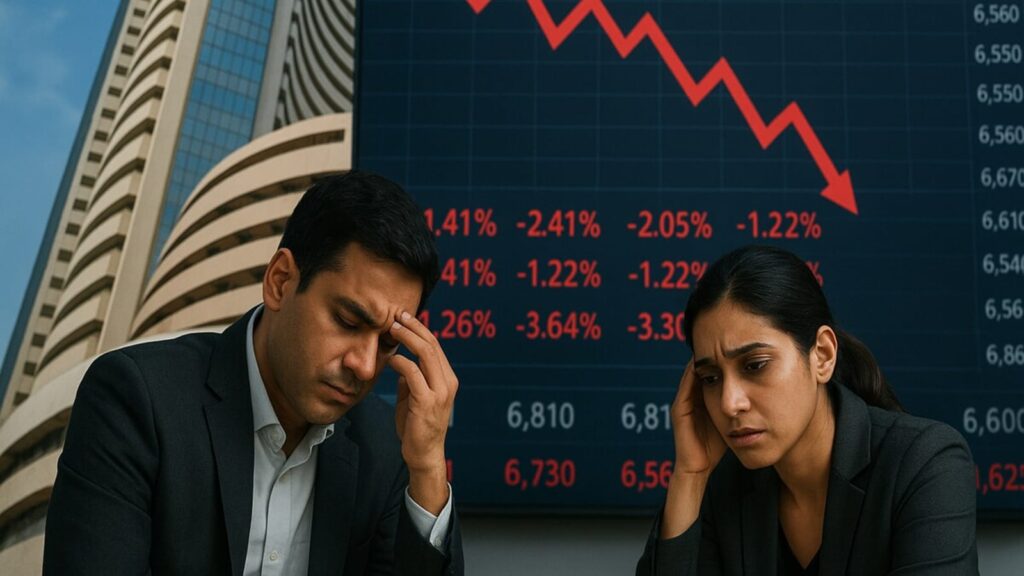
### Understanding the Sensex and Market Volatility
The **Sensex crash reasons** are often rooted in a complex interplay of global and domestic factors, but understanding the index itself is the first step. The Sensex, an abbreviation for “Sensitive Index,” stands as a pivotal benchmark index of the Bombay Stock Exchange (BSE) in India. Comprising 30 financially robust and well-established companies listed on the BSE, it meticulously represents diverse sectors of the Indian economy. This index serves as a critical barometer, offering insights into the overall health and performance of India’s stock market and its broader economic landscape. Investors, analysts, and policymakers meticulously track its movements to gauge market sentiment and identify emerging economic trends [Source: Livemint].
#### What is Market Volatility?
Market volatility, a term frequently encountered in financial discussions, refers to the rate at which the price of a security, such as a stock, or an index like the Sensex, fluctuates over a specified period. High volatility signifies that market values can undergo dramatic and rapid changes, moving significantly in either an upward or downward direction. Conversely, low volatility suggests more predictable and stable price movements. Quantitatively, volatility is frequently assessed using the standard deviation of returns, which measures the dispersion of prices around their average value [Source: Investopedia]. Understanding the sources of this volatility is key to deciphering **Sensex crash reasons**.
Several fundamental factors contribute to market volatility:
* **Economic Indicators:** Key reports pertaining to inflation, unemployment rates, Gross Domestic Product (GDP) growth, and interest rate adjustments can profoundly influence investor confidence, often triggering significant market fluctuations [Source: The Economic Times]. These indicators are crucial in assessing the likelihood of a Sensex crash.
* **Political Instability and Geopolitical Events:** Major global events, including armed conflicts, national elections, shifts in government policies, and complex international relations, introduce considerable uncertainty. This uncertainty often prompts investors to react swiftly, leading to rapid buying or selling of assets.
* **Company-Specific News:** Information directly related to the constituent companies of an index, such as quarterly earnings reports, announcements of mergers and acquisitions, new product launches, or even corporate scandals, can cause their individual stock prices—and consequently the broader index—to fluctuate significantly.
* **Investor Sentiment and Speculation:** Beyond fundamental data, psychological factors like pervasive fear or rampant greed can drive irrational investment decisions, exacerbating market swings and contributing to sharp rises or falls.
* **Global Market Trends:** The Indian market does not operate in isolation. Prevailing global economic conditions and significant events in international markets can create a ripple effect, directly influencing the Sensex. For instance, a global sell-off can trigger declines even in fundamentally strong local markets [Source: Business Standard].
#### Historical Examples of Major Sensex Corrections
The history of the Indian stock market is punctuated by several significant corrections and crashes, serving as powerful illustrations of the inherent volatility within financial markets. These periods provide invaluable lessons for investors seeking to understand **Sensex crash reasons** and market resilience:
* **Harshad Mehta Scam (1992):** This infamous financial scandal involved widespread stock manipulation, leading to a profound crisis of investor trust. The subsequent unraveling of the scam caused a sharp and substantial decline in market values, marking one of the earliest major Sensex crashes in modern Indian financial history.
* **Asian Financial Crisis (1997-1998):** Although its epicenter was in East Asian economies, the crisis had a far-reaching impact on global markets. India, despite its relatively insulated financial system at the time, felt the reverberations, leading to a noticeable decline in the Sensex as foreign capital exited emerging markets.
* **Dot-com Bubble Burst (2000):** The collapse of the technology stock bubble, initially in the US, had a global contagion effect. Indian IT stocks, which had seen significant speculative interest, suffered a downturn, contributing to a broader fall in the Sensex. This demonstrated the interconnectedness of global tech trends and local market performance.
* **Global Financial Crisis (2008):** Triggered by the subprime mortgage crisis in the United States, this event spiraled into a worldwide financial meltdown. The Sensex experienced one of its most severe contractions, plummeting by over 50% from its peak. This was a stark reminder of how global systemic risks can lead to domestic **Sensex crash reasons** [Source: Financial Express].
* **COVID-19 Pandemic (2020):** The unprecedented global health crisis led to widespread economic shutdowns, travel restrictions, and extreme uncertainty across all sectors. This triggered an immediate and sharp decline, with the Sensex crashing by over 38% in a very short span. However, robust government and central bank interventions, coupled with rapid vaccine development, led to a remarkably strong and quick recovery [Source: Business Today].
Understanding these historical events underscores that market corrections and even full-blown crashes, while often painful, are an inherent and normal part of investing within dynamic financial markets. They highlight the diverse **Sensex crash reasons** that can emerge from economic, geopolitical, and internal market forces. For further insights into stock market dynamics, consider reading our article on Understanding Share Price Dynamics.
### Economic Indicators and Triggers
Economic indicators serve as vital barometers, not only for assessing the current health of an economy but also for predicting future market movements. These indicators are among the primary **Sensex crash reasons** when they turn negative. Key among them are inflation, changes in interest rates, and Gross Domestic Product (GDP) growth, all of which significantly influence corporate earnings, investor sentiment, and ultimately, the stability of the stock market, particularly during periods of economic uncertainty or downturns.
#### Inflation: The Erosion of Purchasing Power
Inflation, fundamentally defined as the rate at which the general level of prices for goods and services is consistently rising, directly erodes the purchasing power of currency. While a moderate level of inflation is often viewed as a sign of healthy demand and economic growth, persistently high inflation can have a multifaceted and largely negative impact on corporate earnings. For businesses, high inflation translates to increased costs for raw materials, labor, and operational expenses, inevitably compressing profit margins. Companies may attempt to mitigate this by passing these elevated costs onto consumers through higher prices, but this strategy can simultaneously lead to reduced sales volume as consumer purchasing power diminishes. From an investor’s perspective, high inflation is generally viewed negatively because it erodes the real return on investments, increasing uncertainty and potentially leading to a flight of capital from equities to safer assets, thereby contributing to **Sensex crash reasons** [Source: Investopedia]. Central banks often respond to high inflation by tightening monetary policy, which can further dampen market enthusiasm.
#### Interest Rate Changes: The Cost of Capital
Changes in interest rates, predominantly orchestrated by central banks such as the Reserve Bank of India (RBI) or the US Federal Reserve, are among the most powerful economic levers. When central banks decide to raise interest rates, borrowing becomes more expensive for businesses. This directly impacts their ability to secure loans for expansion projects, undertake new capital investments, and manage existing debt obligations. The increased cost of capital can lead to reduced corporate profits, stifle growth initiatives, and consequently depress stock valuations. For consumers, higher interest rates translate into more expensive loans for significant purchases like homes and automobiles, which can dampen overall consumer spending and investment. Conversely, a reduction in interest rates is designed to stimulate borrowing and spending, injecting liquidity into the economy, boosting corporate earnings, and often fostering greater investor confidence, which can prevent a Sensex crash. The profound impact of the Fed on Wall Street today provides a parallel insight into how such policies globally influence markets.
#### GDP Growth: The Economy’s Pulse
Gross Domestic Product (GDP) growth measures the total monetary value of all goods and services produced within an economy over a specific period. A robust and consistent GDP growth rate typically signifies a strong, expanding economy. In such an environment, businesses are generally thriving, employment levels are high, and consumer spending is healthy. This virtuous cycle usually translates into higher corporate earnings, increased investment, and positive investor sentiment, supporting stock market growth. Conversely, a contraction in GDP—defined as negative growth, particularly for two consecutive quarters—is a strong indicator of a recession. During economic downturns, corporate revenues invariably decline, profits shrink, and businesses often scale back operations, leading to job losses and reduced investment. This environment inevitably saps investor confidence, leading to significant stock market declines and highlighting key **Sensex crash reasons** [Source: U.S. Bureau of Economic Analysis (BEA)]. Understanding Sensex fall explained: investor insights provides a specific view of how economic contractions affect the Indian market.
#### Overall Investor Sentiment During Downturns
When these economic indicators collectively point towards a deteriorating outlook, they create an exceptionally challenging environment for investors. A scenario of high inflation coupled with rising interest rates, known as stagflation, is particularly concerning, as it implies stalled economic growth alongside climbing prices. A contracting GDP simply confirms the economic slump. In such periods, investor sentiment often turns sharply bearish, with market participants becoming highly risk-averse. This collective fear can result in significant market volatility, widespread selling pressures across all asset classes, and a distinct shift towards defensive investments (e.g., government bonds, gold, or stable, dividend-paying stocks). Companies with strong balance sheets, diversified revenue streams, and resilient business models are better positioned to weather these storms, but even they face considerable pressures on their earnings and market valuations. The collective impact of these adverse economic signals often leads to a Sensex crash.
### Global Events and Geopolitical Tensions
The Sensex, as India’s premier stock market index, operates within a deeply interconnected global financial ecosystem. It is therefore not immune to international dynamics, often reacting swiftly and significantly to global market trends, major geopolitical developments, and fluctuations in international commodity prices. This interconnectedness highlights how the performance of the local Indian market can frequently be a direct reflection of broader global forces, often serving as crucial **Sensex crash reasons**.
#### International Market Trends and Their Ripple Effect
Global economic indicators and prevailing international market sentiment exert a substantial influence on the Sensex. For instance, the release of major economic data from powerhouse economies such as the United States, China, or the Eurozone—including figures on GDP growth, inflation rates, or critical interest rate decisions by influential central banks like the US Federal Reserve or the European Central Bank—can trigger widespread ripple effects across international markets, including India. A deceleration in global economic growth or the onset of a recession in major economies typically fosters a “risk-off” sentiment among global investors. This often prompts foreign institutional investors (FIIs), who hold significant stakes in Indian equities, to withdraw capital from emerging markets like India, thereby exerting downward pressure on the Sensex and potentially contributing to a Sensex crash. Conversely, robust and positive global cues can invigorate investor confidence, leading to increased capital inflows into Indian markets and fostering an upward trajectory for the index [Source: WorldGossip.net]. Factors such as global liquidity, trade volumes, and the performance of major global indices like the S&P 500 or the Dow Jones Industrial Average are constantly monitored for their potential impact on Indian markets.
#### Geopolitical Conflicts: Uncertainty and Disruption
Geopolitical tensions and armed conflicts around the world introduce an immense degree of uncertainty into financial markets. Events such as interstate wars, significant trade disputes between major economic blocs, political instability in strategically vital regions, or even large-scale cyber warfare can severely disrupt global supply chains, impede international trade flows, and create extreme market volatility. For example, conflicts erupting in major oil-producing regions can lead to rapid and sharp spikes in crude oil prices. This is a particularly critical concern for India, which is a net importer of a significant portion of its oil requirements. The Sensex typically reacts negatively to such escalations, driven by concerns about their wide-ranging economic consequences, including potential inflationary pressures, slower economic growth, and increased fiscal deficits. Broader discussions and actions surrounding global trade policies, such as the imposition of tariffs or protectionist measures, can also create significant headwinds for India’s export-oriented sectors, affecting overall market sentiment and often appearing as a top **Sensex crash reasons** [Source: WorldGossip.net]. The stability of international relations is thus paramount for market stability.
#### Fluctuations in Commodity Prices: Oil and Gold’s Influence
The prices of key global commodities, most notably crude oil and gold, have a direct and often immediate bearing on the Sensex. Given India’s substantial reliance on oil imports, a rise in international crude oil prices can significantly inflate the country’s import bill, widen its current account deficit, and intensify inflationary pressures within the domestic economy. Such a scenario can compel the central bank to consider higher interest rates, which typically dampen corporate earnings and depress investor sentiment, causing the Sensex to fall [Source: WorldGossip.net]. Conversely, a sustained drop in crude oil prices can provide a substantial boost to the Indian economy by reducing import costs, easing inflationary pressures, and improving the fiscal balance.
Gold, often revered as a safe-haven asset, tends to see its price appreciate during periods of heightened global economic uncertainty, financial instability, or escalating geopolitical tensions. While gold’s direct impact on the Sensex is generally less pronounced than that of crude oil, its price movements can serve as an important signal of broader investor concerns about overall market stability. A sustained rally in gold prices might indicate a shift in investor preference away from riskier assets like equities, potentially drawing investments away from the stock market and contributing to a Sensex crash [Source: WorldGossip.net]. Beyond oil and gold, prices of other critical commodities such as industrial metals (e.g., copper, steel) and agricultural products can also impact specific Indian industries, influencing their profitability and stock performance, thereby indirectly affecting the Sensex.
### Domestic Factors and Corporate Performance
While global dynamics play a significant role, internal market dynamics within India are equally pivotal in shaping investor confidence, influencing corporate performance, and determining overall market stability. Several domestic factors, ranging from the financial health of individual corporations to shifts in regulatory policies, can profoundly influence how companies perform and how investors perceive their underlying value, often highlighting critical **Sensex crash reasons**.
#### Corporate Earnings Reports: The Fundamental Driver
Corporate earnings reports are arguably the primary and most immediate drivers of investor sentiment. When companies announce robust earnings, particularly those that surpass market expectations, investor confidence tends to surge, often leading to a corresponding increase in stock prices. Strong earnings signal healthy business operations, effective management, and potential for future growth. Conversely, disappointing earnings results, especially those falling short of analyst forecasts, can trigger a sharp decline in investor trust and a rapid fall in stock valuations, as vividly demonstrated by the dynamics of share price movements. These quarterly or annual reports offer a crucial snapshot of a company’s profitability, operational efficiency, and future outlook, directly influencing investment decisions and overall market stability. A series of poor earnings reports from leading companies can be a significant **Sensex crash reason**. Beyond net profit, investors also scrutinize revenue growth, profit margins, and earnings per share (EPS) as indicators of a company’s financial health.
#### Financial Scandals: Eroding Trust and Stability
Financial scandals, encompassing illicit activities such as fraudulent accounting practices, insider trading, embezzlement, or widespread corporate governance failures, can have devastating and far-reaching effects. They severely erode public trust in corporations and the broader financial system, often leading to precipitous decreases in the stock prices of the implicated companies. Such scandals typically trigger stringent regulatory investigations, severe legal outcomes for those involved, and substantial reputational damage. The fallout from these events impacts not only the individual company and its shareholders but can also create broader market ripples, affecting investor confidence across the entire market. The collapse of major firms due to fraud underscores the paramount importance of transparent corporate governance and robust ethical practices, as highlighted in analyses of regulatory impacts on stock markets. Historical examples in India, such as the Satyam scandal, serve as potent reminders of how corporate malfeasance can be a potent **Sensex crash reason**.
#### Liquidity Issues: A Sign of Financial Distress
Liquidity issues, characterized by a company’s struggle to meet its short-term financial obligations due to a lack of readily available cash, are a clear signal of financial distress. Such a situation can significantly diminish investor confidence. When a company faces a cash crunch, it may be unable to pay its suppliers, employees, or service its short-term debt, leading to operational disruptions and potential insolvency. This prompts investors to quickly sell off their shares, further destabilizing the company’s market position and potentially affecting related financial instruments or even entire sectors, especially if it involves a large financial institution. Understanding the nuances of banking margins and liquidity is crucial for assessing a company’s financial health and its potential systemic impact on market stability. A widespread liquidity crisis across multiple sectors or a major non-banking financial company (NBFC) could easily become a significant **Sensex crash reason**.
#### Regulatory Changes: Shaping the Market Landscape
Regulatory changes, whether new policies or amendments to existing ones, instituted by government bodies such as the Reserve Bank of India (RBI) or the Securities and Exchange Board of India (SEBI), can profoundly affect corporate performance and investor confidence. New regulations might, for example, increase operational costs for businesses, introduce complex compliance challenges, or restrict certain activities. However, regulations can also significantly enhance market transparency, improve corporate governance standards, and better protect investor interests, thereby fostering long-term market stability and preventing future Sensex crashes. Conversely, deregulation might be implemented to stimulate economic activity by reducing bureaucratic hurdles, but it could also inadvertently expose markets to increased risks and potential instability if not carefully managed. Ongoing discussions surrounding topics like corporate bank licenses or shifts in market oversight underscore the constant and dynamic interplay between government policy and corporate financial health, directly impacting the investment landscape and overall market direction.
### Investor Behavior and Market Psychology
The financial world, in its theoretical construct, often presumes rational decision-making by market participants. However, the reality of market dynamics is far more intricate and frequently influenced by human psychology. Behavioral finance emerged as a discipline to bridge the gap between traditional economic theory and the observable psychological biases that profoundly influence investor decisions and broader market trends. Understanding these psychological aspects—such as the interplay of fear and greed, the dynamics of speculation, and the phenomenon of panic selling—is absolutely crucial for comprehending market dynamics, especially during periods of extreme volatility, such as a Sensex crash. These human elements are often overlooked yet powerful **Sensex crash reasons**.
#### The Driving Forces: Fear and Greed
At the very core of investor behavior lie two exceptionally powerful and often contradictory emotions: fear and greed. Greed typically propels investors to aggressively seek maximum returns, frequently leading to overly optimistic investing and sometimes irrational exuberance. This emotional drive can manifest as an eager chase after rapidly rising assets, often with a disregard for underlying fundamental valuations. This can contribute to asset bubbles, setting the stage for a future Sensex crash. Conversely, fear becomes the overwhelmingly dominant emotion during market downturns, prompting investors to prioritize minimizing losses, sometimes at virtually any cost. The relentless struggle between these two primal forces can generate significant and often unpredictable fluctuations in market sentiment and asset prices, defining the cyclical nature of market booms and busts.
#### Speculation and Market Bubbles: The Illusion of Easy Wealth
Speculation, predominantly fueled by unchecked greed, plays a monumental role in the formation and eventual bursting of market bubbles. A market bubble occurs when the prices of certain assets rise rapidly and significantly beyond their intrinsic or fundamental value. This surge is primarily driven by widespread investor enthusiasm and the expectation of continuous future price increases, rather than being supported by underlying economic growth or the actual performance of the companies involved. Investors, eager to capitalize on what appears to be a guaranteed upward trend, pour capital into these overvalued assets, further inflating prices. This speculative frenzy often leads to a dangerous detachment from economic reality, creating an unsustainable growth trajectory. The eventual bursting of these bubbles leads to sharp and often devastating price corrections, frequently initiating a Sensex crash. History is replete with examples, from the infamous Tulip Mania to the Dot-com bubble.
#### Panic Selling and Market Crashes: The Cascade of Fear
When a market bubble inevitably bursts, or when a significant economic shock strikes, fear rapidly and overwhelmingly replaces greed, triggering a wave of panic selling. During a market crash, investors, driven by an intense and overwhelming desire to avoid further losses, begin to sell their holdings indiscriminately, often without considering the long-term value of their assets. This herd mentality accelerates the downward spiral, as falling prices incite even more selling, creating a dangerous and self-fulfilling prophecy. The psychological impact on investors can be severe, leading to significant wealth destruction, profound emotional distress, and prolonged periods of market instability. Understanding these powerful dynamics of human behavior is essential for navigating turbulent financial landscapes and provides crucial insights into historical events like the 2008 global financial crisis or the dot-com bubble burst. A collective panic can swiftly turn a market correction into a full-blown Sensex crash, as rational decision-making is sidelined by primal survival instincts.
By actively recognizing the powerful and often irrational influence of psychological factors on investment decisions, individuals can strive to make more informed, disciplined, and long-term-oriented choices, rather than succumbing to the emotional swings that frequently characterize market extremes and contribute to **Sensex crash reasons**. For further insights into market movements, consider exploring articles on Sensex fall explained: Investor Insights or Understanding Share Price Dynamics.
### Sources
*
*
*
*
*
*
*
*
*
*
*
*
*
*
*
*
*
*